The COE expiry date always seems far away – until it is not.
One day, you still have a year left. The next time you check, there are only a few months to go and you are receiving very different offers for the same car. One dealer says the car should be scrapped. Another thinks it can be exported. A third gives you a figure without explaining whether it includes the PARF or COE rebate.
That is usually where the confusion begins.
Before accepting an offer, it helps to understand what the buyer is actually paying for. The highest-looking quotation is not always the amount that ends up in your bank account.
Start by Separating the Three Numbers
When comparing quotations, do not treat every figure as one lump sum. Ask the buyer to separate the following:
- Your estimated PARF and COE rebates
- The amount offered for the physical car
- Any collection, towing or administrative charges
This makes it much easier to compare one offer with another.
PARF and COE rebates
Depending on the age of your car and when it is deregistered, you may qualify for PARF and COE rebates.
The COE rebate is based on the unused portion of the COE. In other words, deregistering a car before its COE expires may leave you with a rebate for the remaining period. Once the COE has expired, there is no unused period left.
PARF eligibility depends on the car's age and registration details. Rather than relying on a rough estimate from a dealer, check the vehicle's rebate information through the official OneMotoring service first.
The car's body value
The body value is the commercial value of the actual vehicle.
This amount can vary considerably. A complete car with a working engine and gearbox may have export demand. Another vehicle of the same age may be worth less because it has major accident damage, missing components or serious mechanical problems.
The badge on the bonnet is only one part of the calculation. Buyers may also look at:
- The exact model and variant
- Engine and gearbox condition
- Accident history
- Mileage
- Whether the car can still be driven
- Demand for the vehicle overseas
- Demand for its used components
- Whether important parts have already been removed
This explains why two cars with similar COE expiry dates can receive very different offers.
When Exporting the Car May Make More Sense
Suppose you have a car that still starts normally, has not suffered major accident damage and is complete inside and out. Even if its COE is nearing the end, the vehicle may still have value in another market.
A used car exporter in Singapore may consider the demand for that particular model overseas. Popular Japanese models, commercial vehicles and certain continental cars may attract interest depending on the destination market and current buying demand.
Exporting is not automatically more profitable, though. Shipping, port handling, storage and documentation all cost money. A buyer has to calculate these expenses before deciding what the car is worth.
This is why an exporter's offer may change from one month to another. Demand in overseas markets changes, freight costs move and buyers may already have enough stock of a particular model.
When asking whether you can export a car from Singapore, provide the exact model, registration year and photographs. A vague description such as "2016 Toyota" is not enough for an accurate assessment.
When Scrapping Is the More Practical Option
Scrapping may be more suitable when the car:
- Has severe accident damage
- Has a failed engine or gearbox
- Has been left unused for a long time
- Is incomplete
- Has little demand as a complete export vehicle
- Would cost too much to prepare for export
That does not mean every part of the car is useless.
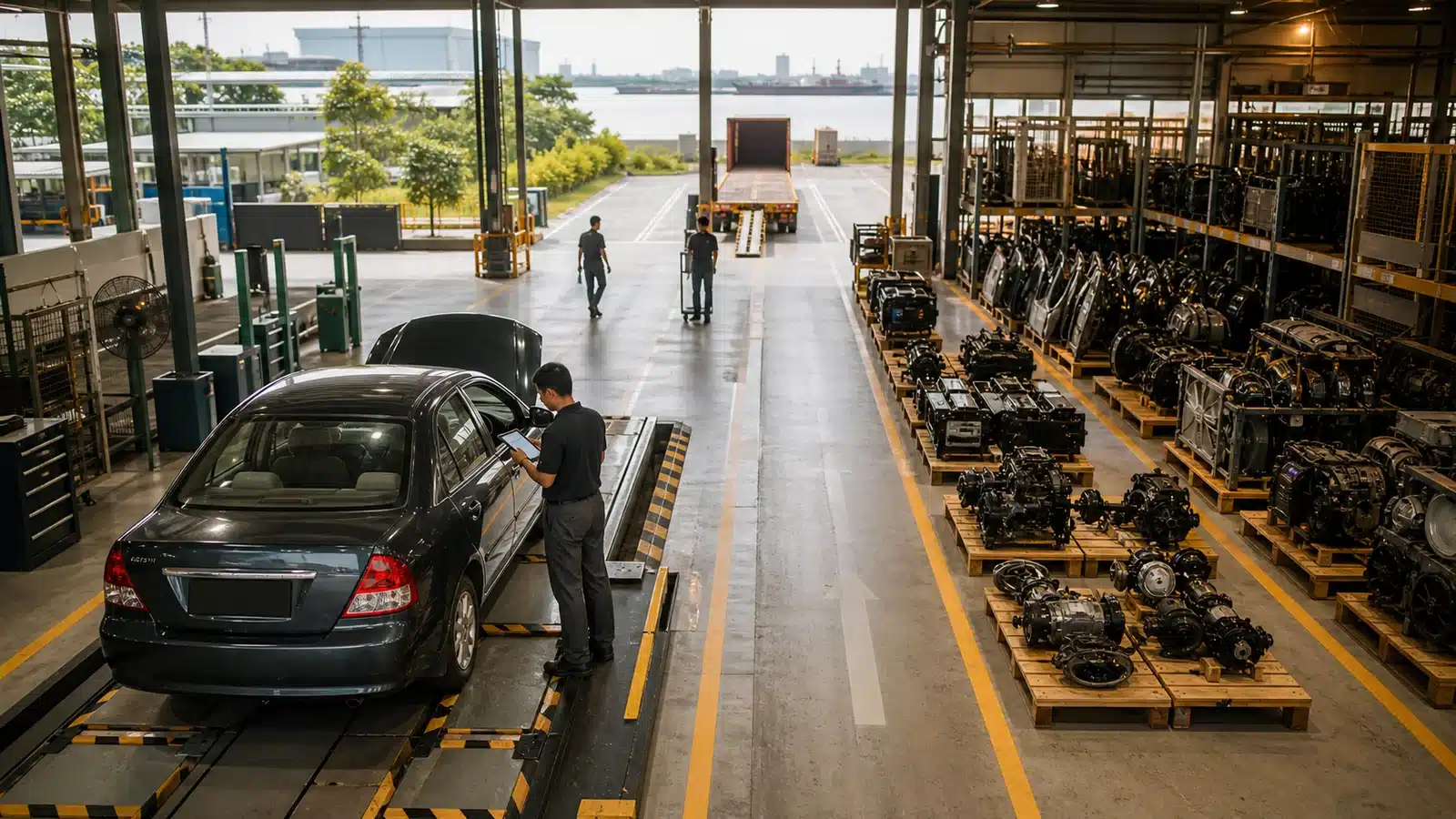
A dismantler may still recover an engine, gearbox, rims, lighting, body panels, interior pieces or other components that remain in usable condition. Materials that cannot be reused may be separated for recycling.
A badly damaged front end, for example, does not necessarily mean the rear doors, seats, rims and gearbox have no value. The car needs to be assessed as a collection of components, not only as one complete vehicle.
Do Not Deregister the Car Before You Understand the Process
This is one of the most important points.
Once a vehicle has been deregistered, it can no longer be kept or driven for normal use in Singapore. A deregistered vehicle must be moved by towing or transport rather than driven on the road. See the LTA deregistration guidance.
LTA recognises three methods of disposing of a deregistered vehicle:
- Scrapping it at an LTA-appointed scrapyard
- Temporarily storing it at an LTA-appointed Export Processing Zone
- Exporting it and providing the required documents
The registered owner is responsible for making sure the vehicle is properly disposed of. Proof of disposal must generally be submitted to LTA within one month of deregistration. The steps can differ depending on whether the car is PARF-eligible and which disposal method is being used.
For that reason, do not deregister the car simply because someone has sent you a promising WhatsApp quotation.
First, confirm:
- Where the car will be collected or delivered
- Whether it will be scrapped or exported
- Who is responsible for each part of the paperwork
- When payment will be made
- What proof of disposal you will receive
- What happens if the buyer changes the offer after inspection
A professional buyer should be able to explain the sequence clearly.
What to Send When Requesting a Scrap-Car Quote
A buyer can only work with the information you provide. The more accurate your description, the less likely the quotation is to change later.
Send the buyer:
- The make, model and exact variant
- Original registration date
- COE expiry date
- Current mileage
- Engine capacity
- Photographs of all four sides
- Photographs of the interior
- A photograph of the engine bay
- Details of any accident damage
- Details of major mechanical faults
- Information on whether the car can still be driven
Do not hide a failed gearbox, warning light or accident repair. It will almost certainly be noticed during inspection, and the buyer may revise the offer.
A clear description protects both sides.
Questions Worth Asking Before You Accept an Offer
- Is this figure only for the car body, or does it include the rebates?
Is collection included?
Will there be deductions after inspection?
When will I be paid?
Is the car being scrapped locally or prepared for export?
Who will handle the disposal documents?
How long is this quotation valid?
When people search online for "scrap my car in Singapore", it is tempting to contact several companies and choose the highest number. A better approach is to ask each buyer the same questions.
Get the important details in writing. A message or written quotation is better than relying on a telephone conversation that neither party can refer to later.
Should You Remove Valuable Parts Before Scrapping?
Some owners consider removing the rims, audio system, seats or other valuable components before selling the car.
That can make sense in certain situations, but check with the buyer first. Removing parts may reduce the amount offered for the complete vehicle. An exporter may also be less interested in an incomplete car, even when the missing items appear minor.
Calculate what you can realistically sell the parts for, how long the sale may take and what removal will cost. Keeping a set of rims is not worthwhile if the body quotation drops by more than the amount you can recover.
How Everise Auto Handles End-of-Life Vehicles
Everise Auto buys end-of-life vehicles across different makes and models. Its operations include vehicle buying, dismantling, parts recovery, packing and export. The company also supplies recovered used components to local buyers.
Because the business handles both vehicles and parts, the team can assess whether a car has potential as a complete export vehicle, a source of reusable components or a vehicle for scrapping.
To request an assessment, send the team your vehicle details, COE expiry date and clear photographs. Mention any accident damage or mechanical problems at the beginning so the quotation is based on the car's actual condition.
The Best Time to Ask for a Quote
Do not wait until the final few days of the COE.
Starting earlier gives you time to:
- Check your official rebate information
- Compare several offers
- Settle any outstanding financing
- Decide whether to retain the registration number
- Arrange collection or delivery
- Understand the deregistration process
A rushed owner has fewer choices. An informed owner can compare the value, paperwork and convenience of each offer before making a decision.
The goal is not simply to find the nearest scrapyard in Singapore. It is to understand what your car is worth, how it will be disposed of and what you will actually receive after the handover.
Editorial references
- LTA OneMotoring – Deregister a Vehicle
- LTA OneMotoring – PARF and COE Rebates
- Everise Auto – Scrap Car Singapore Services
- Everise Auto – Scrap and Pack / Auto Parts Export