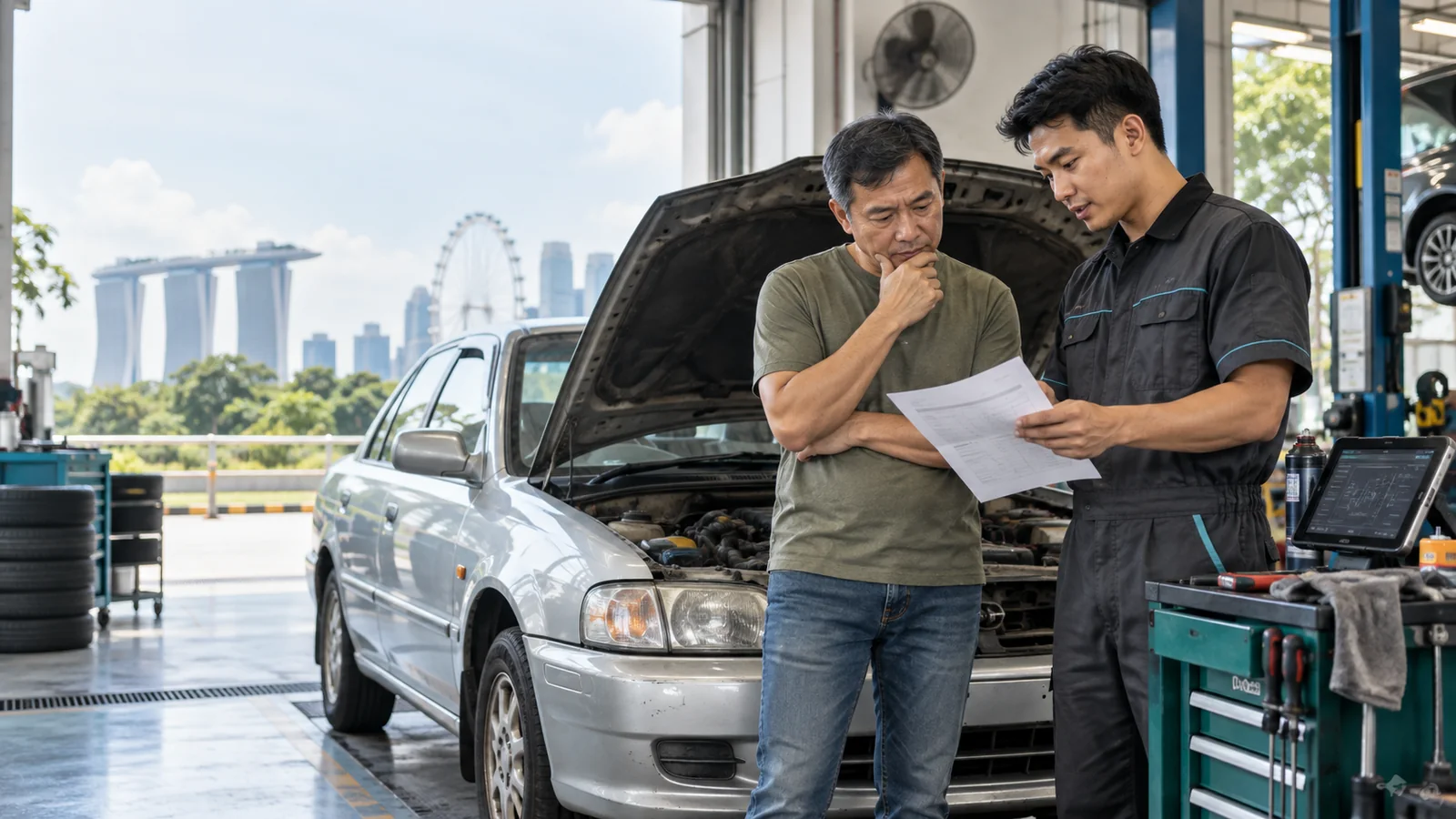
A growing repair estimate can turn a routine workshop visit into a much bigger decision. If it has you searching for sell your car Singapore options, pause before approving the job. The car may still run, but that does not automatically make another large repair the best use of your money.
One expensive fault is not a reason to give up on an otherwise dependable car. The picture changes when the same problems return, workshop visits are becoming routine, or another costly maintenance item is already due.
Before approving the work, compare the three realistic options in front of you:
- Repair the vehicle and continue using it.
- Sell the vehicle in its current condition.
- Dispose of it through export, parts recovery or scrapping.
The aim of this guide is simple: compare what the car is worth now, what the repair is likely to achieve, and what continued ownership could cost before you commit more money.
Quick Answer: When Does a Car Stop Being Worth Repairing?
A car becomes hard to justify when today’s repair bill, the work likely to follow, and the disruption of keeping it on the road are greater than the useful value you expect to get back.
It may be time to look seriously at selling or scrapping when:
- The same fault keeps returning
- Several major components need attention
- The car frequently leaves you without transport
- Replacement parts are difficult or expensive to find
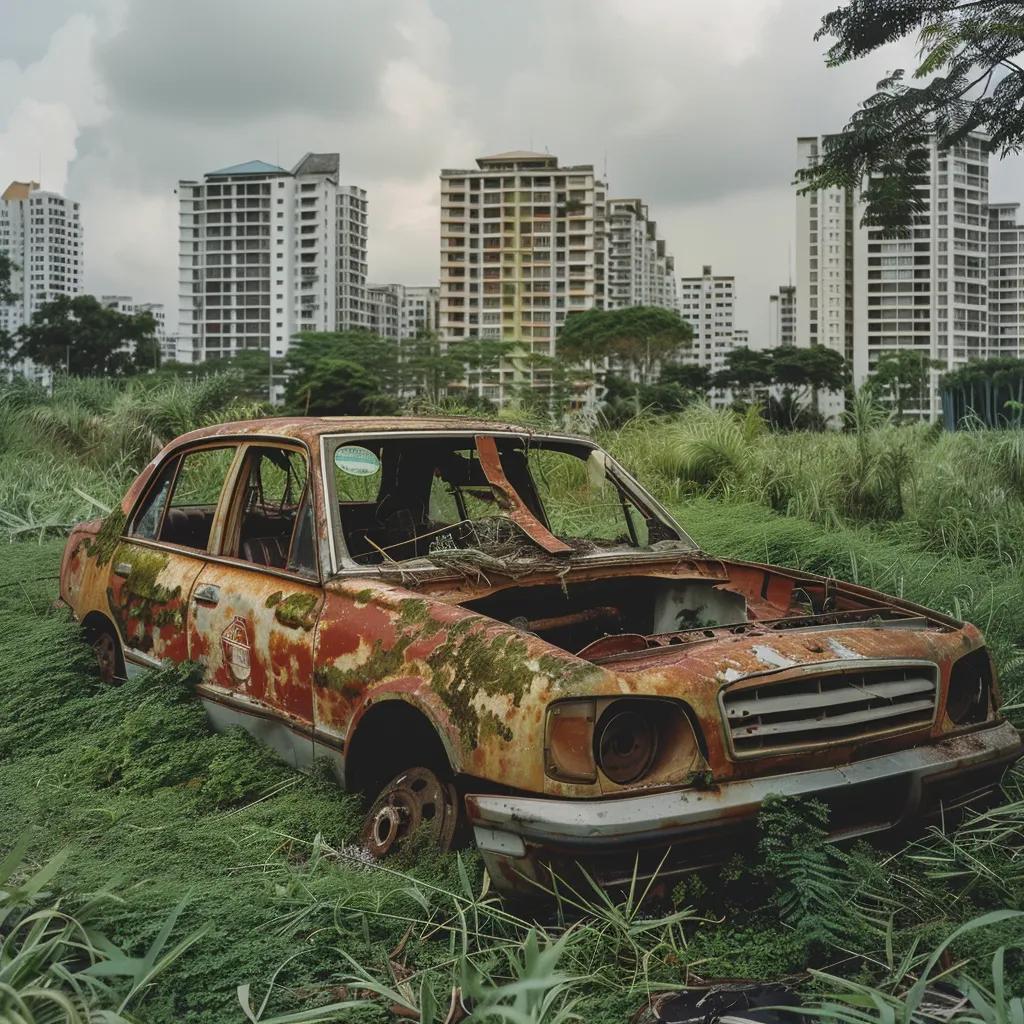
- The vehicle has serious accident, flood or fire damage
- The repair will not significantly improve its resale value
- The car is approaching another expensive maintenance stage
- A buyer’s as-is offer is close to what you would receive after completing the repair
There is no universal dollar figure at which a car should be scrapped. The same bill can be reasonable for a reliable vehicle and a poor bet for one with several unresolved faults.
Start With Five Real Numbers
Before deciding, put five figures on one page. They can be estimates; the point is to replace a stressful yes-or-no choice with a comparison you can actually see.
1. The current as-is value
First, find out what someone would genuinely pay for the vehicle in its present condition.
This could include quotations from:
- A used-car dealer
- A direct buyer
- A vehicle exporter
- A dismantler or parts buyer
- A scrap-car company
Be direct about the car’s condition with every buyer. A quote based on a fully operational vehicle is not useful if the price will change as soon as the bonnet is opened.
2. The full repair cost
Do not focus only on the headline item in the workshop quotation.
Ask whether the estimate includes:
- Labour
- Replacement parts
- Fluids
- Diagnostic work
- Programming or calibration
- Towing
- Taxes and workshop charges
- Related parts that may need replacement during the repair
Once a major component is removed, the workshop may discover worn hoses, mounts, seals or electrical parts that were not included in the first estimate.
3. The likely value after repair
A four-figure repair does not automatically add the same amount to the selling price.
Most buyers see the repair as bringing the car back to a normal operating condition, not as an upgrade worth paying the full repair cost for.
Ask yourself:
If I spend this amount today, how much more could I realistically receive when I sell the car?
If the likely increase in selling price is far smaller than the bill, repairing the car only to sell it may not be worthwhile.
4. The likely cost of the next 12 months
The current fault may not be the only cost waiting around the corner.
Consider whether the car may soon need:
- Tyres
- Brakes
- Suspension work
- Air-conditioning repair
- Battery replacement
- Cooling-system work
- Gearbox servicing
- Engine seals
- Electronic repairs
- Scheduled major maintenance
Looked at separately, each repair can seem manageable. Add the likely work for the next 12 months and you may see a very different ownership cost.
5. The cost of being without the car
Time off the road costs money too.
Repeated workshop visits can mean taxi fares, rental-car charges, missed appointments and disruption to work or family routines.
That does not mean every inconvenient car should be sold. It simply means reliability belongs in the financial calculation rather than being treated as a separate concern.
A Quick Comparison That Helps
A quick back-of-the-envelope comparison is usually enough:
Repair-and-sell outcome
Estimated value after repair minus the complete repair cost minus any likely near-term expense
Compare that result with:
As-is outcome
The amount a genuine buyer is prepared to pay for the vehicle in its current condition
If the repair produces only a slightly better result, factor in the time, uncertainty and risk involved as well.
The workshop may uncover more problems after the work begins. Your final bill can rise even though the buyer’s post-repair offer stays exactly the same.
This is not an accounting formula. It is a useful check against spending thousands first and only then asking what the alternatives would have paid.

When Repairing the Car Still Makes Sense
A high quote is uncomfortable, but it can still be money well spent when the fault is isolated and the rest of the car has been dependable.
The problem is isolated
One major component may have failed while the rest of the vehicle remains reliable.
If the car has been well maintained, has no serious accident history and is not showing signs of several other problems, fixing the isolated fault may give you useful service for longer.
You know the car’s history
A car whose history you know can sometimes be less risky than another used vehicle with an uncertain past.
You know how the car has been driven, serviced and stored. That knowledge has practical value when comparing it with an unfamiliar replacement.
The repair is supported by a clear diagnosis
A repair is easier to justify when the workshop can identify the cause, explain the work clearly and give you reasonable confidence that the problem will actually be resolved.
Be more careful when expensive parts are being replaced one after another on a trial-and-error basis.
The vehicle still suits your needs
A car may have low resale value but still be useful to its owner.
If it remains suitable for your daily travel, family size and work requirements, keeping it may be more practical than changing vehicles immediately.
The replacement cost would be much higher
Selling the older car may remove the immediate repair bill, but replacing it can bring a deposit, financing, insurance and other ownership costs.
Compare the repair bill with the full cost of changing cars, not just the advertised price of the replacement.
Sell Your Car Singapore: When an As-Is Sale Makes Sense
You do not have to return every car to perfect condition before a buyer will consider it.
An as-is sale can be sensible when the vehicle still has useful value but the repair no longer fits your budget, timing, or plans for the car.
The repair will not add enough resale value
Suppose a repair costs considerably more than the difference between the current as-is offer and the likely post-repair selling price.
In that situation, you may be spending money on work that the next buyer will not fully pay you back for.
The problem is understood and can be disclosed clearly
Some buyers are comfortable taking on a vehicle that needs work, especially when they have access to workshops, parts or export markets.
Share the diagnosis, repair quotation and service information where available. A clear description helps the buyer assess the risk and reduces the chance of disagreements later.
You need certainty more than the highest theoretical price
Repairing the car and selling it privately may produce a higher headline price, but it can also involve workshop delays, advertising, enquiries, viewings and negotiation.
When you need a definite outcome, an as-is sale can be worth more in practice than a higher theoretical price that requires weeks of repairs, listings, viewings, and negotiation.
The car remains complete
A complete vehicle is usually easier for a buyer to evaluate than one from which major parts have already been removed.
Before selling components separately, compare the offer for the whole car. Removing the engine, gearbox, wheels or electronic modules may lower the value and make collection more difficult.
When to Ask for a Scrap or Parts-Recovery Quote
Scrapping is not the default answer for every old vehicle. A scrap car Singapore quote becomes useful when the complete car has limited resale potential or would cost too much to return to reliable road use.
The car cannot be driven economically
A non-running car may need towing, diagnosis and several repairs before a regular retail buyer would consider it.
Even when a car cannot be driven, its mechanical, body, electrical, or interior components may still be usable. Non-running does not mean worthless.
There is serious structural damage
A vehicle with major chassis or structural damage may require extensive work before it can be considered roadworthy again.
In some cases, parts recovery may be more practical than attempting to restore the complete car.
Several major systems are failing
An engine repair may be manageable on its own. The decision changes when the gearbox, air-conditioning, suspension and electronics also need attention.
Once several major systems need work, both the cost and the uncertainty rise quickly.
The vehicle has suffered flood or fire damage
Flood and fire exposure can affect several systems at once, including wiring, sensors, electronic modules, upholstery and mechanical components.
The visible damage may not show the full extent of the problem.
The parts have more practical value than the complete car
Some vehicles have limited demand as complete units but still contain engines, gearboxes, body panels, lights and interior parts needed by other owners.
A dismantler or exporter may therefore assess the vehicle differently from a general used-car buyer.
Do Not Let Yesterday’s Repair Bills Decide the Next One
Many owners keep repairing an unreliable car because of how much they have already spent on it.
They think:
I have already put so much money into it, so I cannot sell it now.
That money has already been spent. It may explain why you feel invested in the car, but it should not be the main reason for approving the next bill.
The better question is:
From today onward, which option gives me the most useful and financially sensible outcome?
Past repairs may have improved the car, but spending more does not guarantee that you will recover what has already been paid.
Make the next decision using the car’s condition today, its current value and the costs likely to come next.
Signs That Another Large Repair May Be Coming
No one can predict every breakdown, but certain patterns are worth paying attention to.
Frequent warning lights
A warning light that returns shortly after repair may indicate that the underlying problem was not resolved or that another connected system is failing.
Repeated overheating
Overheating can affect several engine and cooling-system components. A temporary fix may not address the full cause.
Gearbox hesitation or slipping
Transmission problems can become expensive, particularly when the diagnosis is uncertain or major internal work is required.
Persistent oil or coolant loss
A small leak may be manageable. Repeated fluid loss combined with smoke, overheating or contamination may point to a larger issue.
Increasing electrical faults
Intermittent sensor, locking, lighting, starting and infotainment problems can be difficult to diagnose when several systems are affected.
Parts are becoming difficult to source
An otherwise repairable vehicle can become impractical to maintain when compatible parts are unavailable or take a long time to obtain.
The car repeatedly fails to complete normal journeys
Reliability is not only about whether the vehicle eventually starts. A car that cannot be trusted for regular use is imposing a real cost on its owner.
Three Real-World Scenarios
Situation 1: One major repair, otherwise reliable
The vehicle has a clear mechanical fault, but it has been regularly maintained and has no pattern of repeated breakdowns.
The repair is supported by a clear diagnosis and the owner plans to keep the car.
What to consider: Repairing may still make sense, especially when replacing the vehicle would cost far more.
Situation 2: The car runs, but repair bills keep arriving
The owner has recently paid for suspension, cooling and electrical work. A new gearbox or engine-related repair is now required.
The car can still be sold, but there is concern that more expenses will follow.
What to consider: Obtain both an as-is sale quotation and a parts or export quotation before approving the next repair.
Situation 3: The car is non-running after serious damage
The vehicle requires towing, has major body damage and needs several mechanical components.
Returning it to the road would involve significant cost and uncertainty.
What to consider: A scrap, export or parts-recovery assessment may be more practical than repairing the car for a standard resale.
These scenarios are not fixed rules. They show why the whole vehicle and the owner’s plans matter more than one number at the bottom of a workshop estimate.
If You Decide to Deregister the Vehicle
In Singapore, deregistering a vehicle through LTA cancels its registration, which means it can no longer be kept or used on the road.
LTA currently lists three disposal routes after deregistration: scrapping the vehicle at an LTA-appointed scrapyard, storing it temporarily at an appointed Export Processing Zone pending export, or exporting it. Depending on the vehicle’s age, type and remaining COE period, PARF or COE rebates may apply.
The registered owner remains responsible for properly disposing of the vehicle and submitting the required disposal documents within the applicable period. LTA also advises owners to ensure that a vehicle is not under financing when it is deregistered and notes that outstanding road-tax arrears or other LTA payments may be collected during the transaction.
Do not deregister the vehicle simply because a buyer has given you a quote. Confirm the collection, payment, documentation, and disposal route first.
How to Get a Useful As-Is Quote
A useful quote starts with useful information. Give the buyer enough detail to assess the car realistically.
Prepare:
- Vehicle make and exact model
- Registration year
- Current mileage
- COE expiry date
- Engine and transmission details
- Workshop diagnosis
- Repair quotation, if available
- Accident, flood or fire history
- Information about missing parts
- Current vehicle location
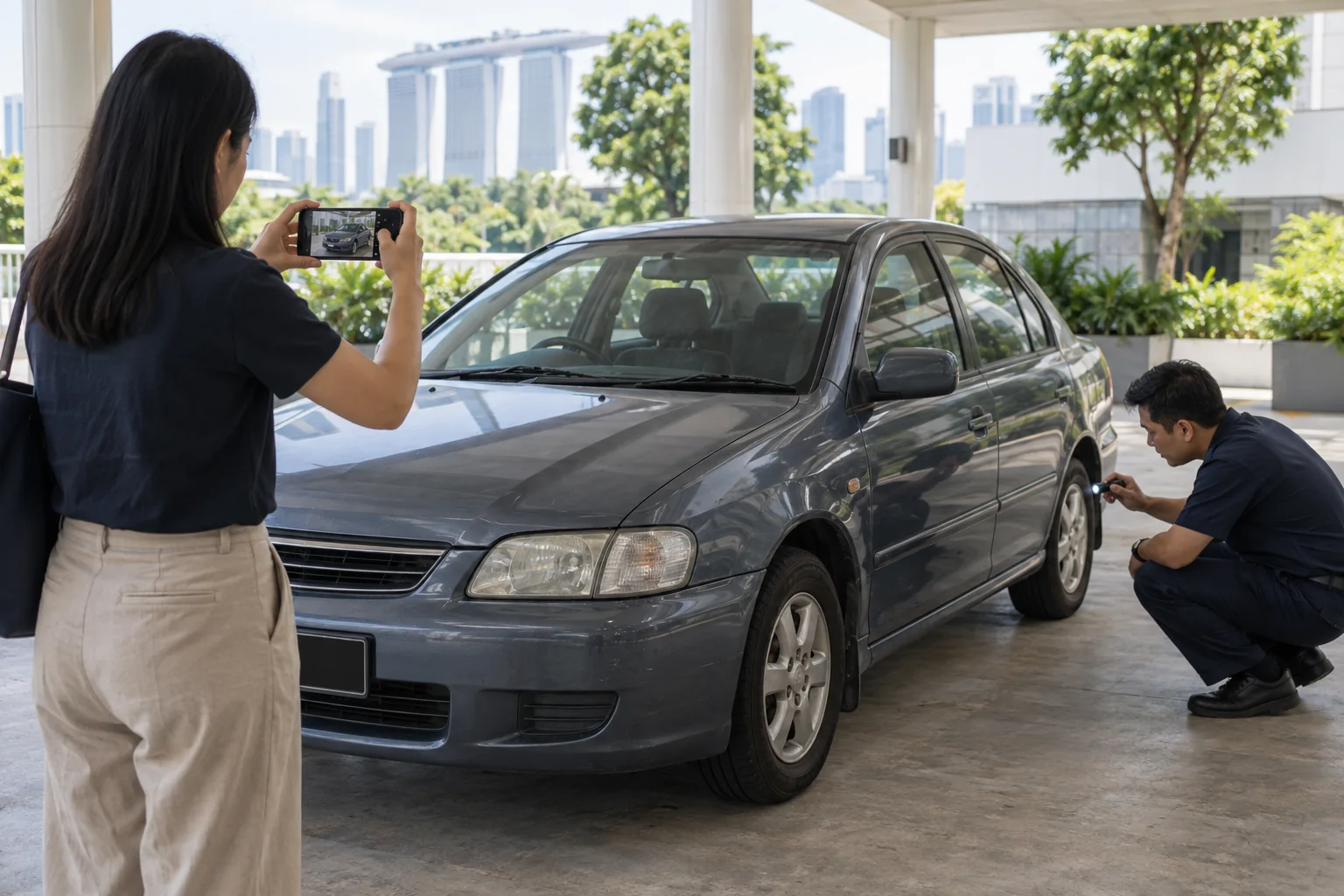
- Clear and recent photographs
Photograph the front, rear, both sides, interior, dashboard, engine compartment and any damaged areas.
Avoid describing the car only as “not working.” Say what happened, what the workshop found, and whether the vehicle can start, roll, steer, and brake.
Clear information protects both sides: the buyer can price the actual condition, and you reduce the chance of a surprise deduction during inspection.
Questions to Ask Before Accepting an Offer
Whether you are selling or scrapping the vehicle, ask the buyer:
- Is the quotation based on the car’s present condition?
- Is the amount final or subject to inspection?
- Is collection or towing included?
- Are there administrative or handling deductions?
- When will payment be made?
- Is the vehicle being resold, exported or dismantled?
- Who will handle the deregistration or disposal paperwork?
- What proof of handover will I receive?
- What happens if the vehicle cannot be moved as expected?
- Which parts and accessories are included in the agreement?
Ask for the important answers in writing. Our collection-day checklist also explains what to prepare before the vehicle is handed over.
A high verbal offer is worth less than a slightly lower written quotation with clear collection, payment and documentation terms.
Should You Remove Accessories Before Selling?
Personal accessories may be removed when they are not included in the agreed sale, but discuss this before handover.
Items may include:
- Dashcams
- Aftermarket audio equipment
- Personalised number-plate frames
- Child seats
- Phone holders
- Parking or access devices
- Removable storage accessories
Do not remove factory-fitted components or major parts after the vehicle has been assessed without telling the buyer.
A quotation for a complete vehicle may be revised if important parts are missing at collection.
How Everise Auto Can Help
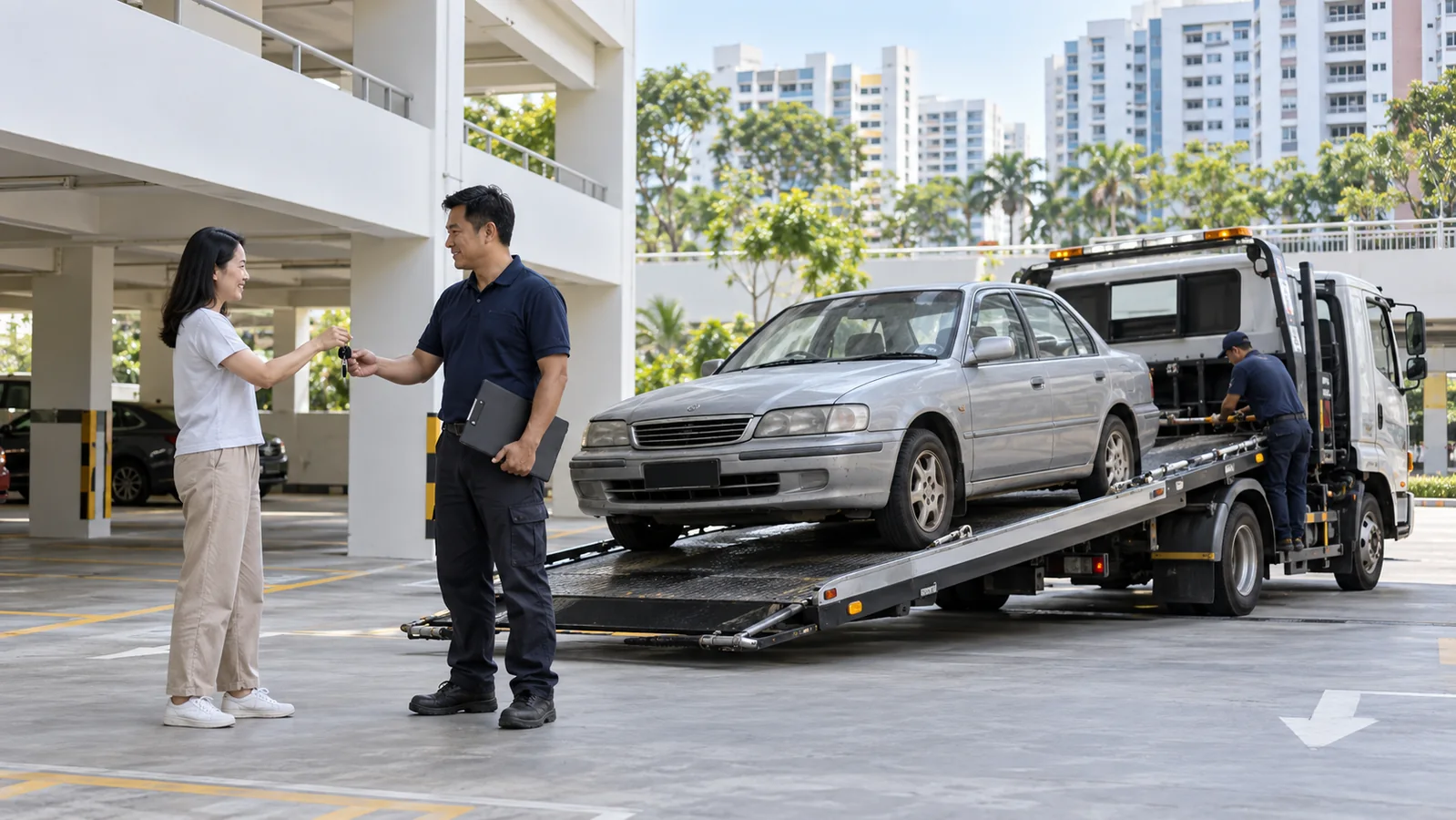
Everise Auto buys end-of-life vehicles and handles dismantling, parts recovery, packing and export. Its vehicle-selling service also covers support with deregistration, PARF and COE payouts, export permits and related administrative work.
This allows a vehicle to be assessed for several possible outcomes:
- Sale in its existing condition
- Complete vehicle export
- Engine or gearbox recovery
- Local used-parts supply
- Overseas parts export
- Scrapping and material recovery
When requesting an assessment, share the vehicle’s true condition together with any workshop diagnosis or repair quotation you have received.
If you are searching for scrap my car Singapore support, the best first step is not immediate deregistration. Start by finding out what the car is worth in its present condition and which route is genuinely practical.
Frequently Asked Questions
Should I repair my car before selling it in Singapore?
Not always. Compare the full repair cost with the likely increase in resale value. When the repair costs more than the additional amount a buyer is likely to pay, selling the vehicle as-is may be more practical.
Is it better to sell a car while it is still running?
A running vehicle may attract more potential buyers and can be easier to inspect and collect. However, repairing a non-running car solely to make it saleable is not always financially worthwhile. Obtain an as-is quotation before approving major work.
Can I sell a car that has engine or gearbox problems?
Yes. Dealers, exporters, dismantlers and parts buyers may still be interested. Disclose the known problem and provide the workshop diagnosis where possible.
Does high mileage mean that I should scrap the car?
No. Mileage is only one factor. Maintenance history, mechanical condition, accident history, reliability and parts availability may be more important than the odometer reading alone.
What if the repair costs more than the car’s market value?
Paying more than the vehicle’s market value for a repair is usually difficult to justify financially. However, personal circumstances, replacement cost and the car’s usefulness may still influence the decision. Compare repair, as-is sale and disposal quotations before proceeding.
Can I scrap a car that is still under financing?
LTA advises owners to ensure that a vehicle is not under financing when it is deregistered. Contact the finance company, request the settlement amount and confirm how the financing interest will be released before arranging disposal.
Will a scrap buyer collect a non-running vehicle?
Collection may be available, depending on the buyer and the vehicle’s location. Explain whether the car can start, roll, steer and brake, and confirm whether towing is included in the offer.
Do I need to deregister the car before asking for a quote?
No. Obtain and compare quotations first. The correct deregistration sequence depends on the vehicle and disposal route, so collection and paperwork should be coordinated before the registration is cancelled.
Can accident-damaged cars still have value?
Yes. A badly damaged car may still contain a usable engine, gearbox, doors, lights, rims, electronic modules or interior components. The value depends on which parts remain usable and current market demand.
How do I decide between selling and scrapping?
Selling may be appropriate when the complete vehicle still has practical resale or export value. Scrapping or parts recovery may be more suitable when repairs are uneconomical, the vehicle is severely damaged or individual components are more useful than the complete car.
Repair, Sell or Scrap: Use Today’s Numbers
Do not let the amount already spent make the next decision for you. Use today’s value, what the proposed repair will genuinely change, and what another year of ownership is likely to cost.
Before approving a major workshop quotation:
- Request the complete repair estimate.
- Check the car’s as-is value.
- Estimate its realistic value after repair.
- Consider likely expenses over the next year.
- Compare the time, risk and inconvenience involved.
When you are ready to sell your car in Singapore, Everise Auto can assess it in its current condition and explain whether an as-is sale, export, parts recovery, or scrapping is the more practical route.
Send the model, registration year, COE expiry date, mileage, workshop diagnosis, and recent photographs to request an assessment before putting more money into the vehicle.